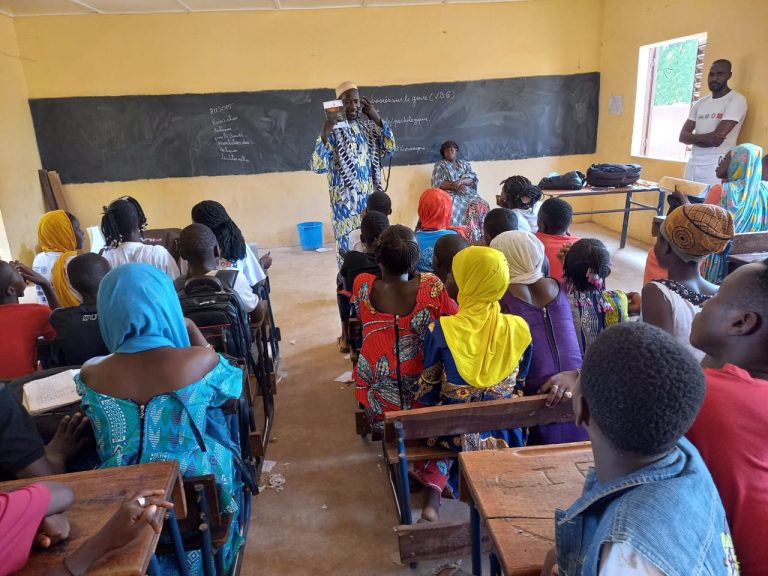
Encadrement des Femmes Indigènes et des Ménages Vulnérables (EFIM) work with local indigenous populations in DRC to build strong community networks to counter sexual and gender-based violence (SBGV). EFIM share how they use a a pleasure-based approach to work with couples to counter violence and inequality in the home, as well as at the community level.
Kitshanga is a town around 90 kilometres from the city of Goma in the Democratic Republic of Congo (DRC). Located in the Masisi territory – an area renowned not only for its fields and livestock but also for its minerals and insecurity – indigenous people living in the neighbouring villages are among the beneficiaries of the current project, run by our organisation Encadrement des Femmes Indigènes et des Ménages Vulnérables (EFIM).
Now in her late thirties and naturally shy, Lukoo welcomes us into her makeshift hut, where she lives with her husband and five children. She has taken part in several of our activities in this part of North Kivu province. Lukoo says,
If I welcome you here today, it’s because my husband and I had a chat and he authorised me to talk to you. All this is thanks to the sharing sessions you organised to help us understand our rights and what we can do together.
Before these activities came along, Lukoo couldn’t sit down with her husband and plan what she could do tomorrow. With his advanced age, her husband no longer has the strength to go to the fields. Lukoo is the sole provider for the family. Her children don’t go to school because they can’t afford it. Her story is not unique in this environment.

A movement for change
The security situation in North Kivu has deteriorated steadily over the years, leading to further displacements and incidents targeting the local population. Clashes have continued between the Congolese armed forces and armed groups in several localities in Masisi and Rutshuru territory, as well as in Nyiragongo territory, near Goma. This situation, which affects all sections of the population, has a much greater impact on women and children.
Serious human rights violations, massacres, killings, rapes, torture and kidnappings have become commonplace in these circumstances. Our organisation, EFIM, does its utmost to come to the aid of the most vulnerable populations by assisting them with the means available.
EFIM advocates the promotion of women’s rights and the rights of vulnerable people, and mobilises people to improve their socio-cultural, political, economic and health conditions. EFIM focuses much of its work on supporting indigenous women and girls. Alongside EFIM, six organisations in three countries – Burundi, Rwanda and eastern DRC – are implementing a project to learn how best to meet the needs of women from Batwa communities (Pygmy Indigenous Peoples). The aim of the project is to develop useful methods for reducing or eliminating sexual and gender-based violence (SGBV) in these communities.

The project has several objectives:
- To encourage Batwa women to take part themselves in protecting and defending their rights;
- To prevent the causes of violence and develop ways of combating GBV;
- To reflect on the positive role of Batwa women and men in the communities; and
- To help Batwa women to set up their own movement to defend themselves against sexual and gender-based violence; and
- To put an end to the sexual exploitation of Batwa women and girls by the end of the project.
EFIM and its partners implement this work using a number of techniques, including:
- Training and information: to remind people of their rights and duties and encourage them to defend them.
- Thematic discussion groups: to discuss and find solutions to common problems. The groups are divided by gender – one discussion group with women, and one with men – before being brought together.
- Community dialogue: to discuss existing negative norms and customs and change them if possible.
- Peer education: to provide guidance and set an example for peers.
Community involvement is our greatest success. We achieved this through the commitment of the beneficiaries and their dependents, as well as the local authorities who appreciate the initiative. A rapid response system is in place, with referrals as a key strategy. Many reported cases are recorded at all levels.
A pleasure-based approach
In addition, through this work, EFIM has integrated a pleasure-based approach, which emphasises the importance of communication, consent and equality in intimate relationships. In Africa, female pleasure remains a sensitive issue in many of our communities. Customs, conservative mores and available education do not allow women to express their desires, even to the man who is their partner. In a patriarchal society, the man’s pleasure takes precedence over the woman’s. With an approach based on pleasure, EFIM opens a dialogue between the men and women of the community to tackle the problems of gender-based violence and find solutions together to the problems of inequality in the home.
The community and the authorities are supportive and accompany the process of behaviour change in all our intervention sites. The interventions reach 180 women and 180 men (including partners and other community members) from 18 villages. The impact identified is:
- The 180 women can now talk about sex with men. They understand that they have the right to say no to SGBV, and to ask for help if they need it. In addition, they have learned about their rights and duties and how to defend them.
- The 180 men are willing to support the women in improving the situation of women and girls in their communities. They have learnt that women have the right to say no to sexual activity, to SGBV, and to seek protection if necessary.
- Ten girls benefitted from sex education sessions to prevent unwanted pregnancies, forced marriages and the freedom to enjoy one’s body. They learned about the concept of pleasure and its relationship to sexual health and empowerment. The young men also take responsibility for supporting the process.

Looking to the future
As successful as the project has been, it has also faced challenges. The first difficulty has been financial. Most of the work sites are a long way from the towns where we live. To access these sites, with the problems of transport and security, we have had to give more time and resources to carry out our activities.
There is also the continuing problem of security, especially at sites in DRC. People are constantly on the move, which makes the task difficult. The project communities, who make their living from farming and hunting, can no longer access their fields. They are in a catastrophic situation.
Nonetheless, the project has achieved more than expected. Several local authorities are encouraging the continuation of these activities, which are also helping to consolidate peace in their localities and villages. Pygmies and non-pygmies have developed habits of peaceful cohabitation as a result of the many community meetings that are now organised.
EFIM and its partners hope that this project will continue to expand the Batwa women’s movement for the protection and defense of their rights by training more women and their partners in their rights and duties. We will support leadership within these communities to enable them to join decision-making bodies. If possible, we will improve the communities’ standard of living by supporting income-generating activities for Batwa women.
For Lukoo, this project and its pleasure-based approach have changed her life and her relationship for the better: